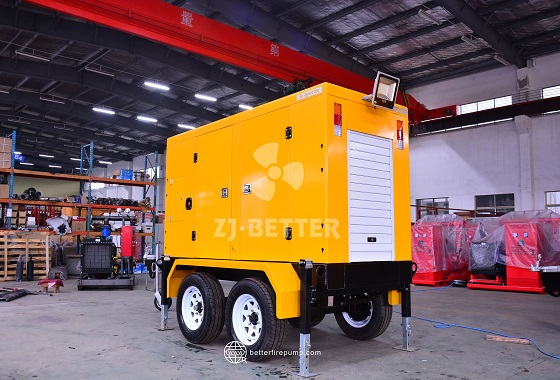
Enclosed Trailer-Mounted Fire Pump Equipment – Integrated Protective Housing and Mobile Chassis Design
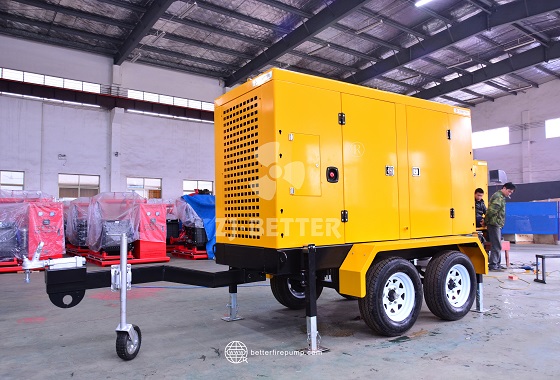
The enclosed trailer-mounted fire pump unit features an integrated design, combining a protective enclosure with a dual-axle mobile chassis. It houses a fire pump, a power system, and control components, offering advantages such as ease of transport, rapid on-site deployment, and convenient equipment maintenance. It is well-suited for temporary or mobile fire-fighting water supply applications.
A trailer-mounted enclosed fire pump unit is a mobile pumping system that integrates a fire pump, a power unit, and related auxiliary components within an enclosed housing, all mounted on a trailer chassis. It is designed for engineering scenarios that require flexible deployment and mobile water supply support. The enclosed housing provides protection for the internal pump assembly and auxiliary equipment, shielding them from rain, dust, and other environmental factors, which improves conditions for both storage and transport. The housing features an integrated design, allowing for the internal arrangement of a diesel engine, fire pump, control system, piping, and other accessories. By consolidating the primary equipment into a self-contained space, the need for complex on-site coordination—often associated with decentralized installations—is minimized. Access doors on the sides of the housing facilitate maintenance, allowing personnel to inspect internal components, connections, and auxiliary systems. External ventilation grilles ensure airflow within the compartment, supporting the cooling requirements of the power unit; the specific ventilation and cooling capacity must be engineered based on the engine’s power output, operational load, and environmental conditions. The unit is built on a trailer chassis equipped with dual-axle wheels and a towing hitch, enabling it to be transported by a suitable towing vehicle and moved between different work sites as needed. Unlike stationary fire pump installations, this trailer-mounted configuration eliminates reliance on a fixed location, making it ideal for temporary fire-fighting water supply, construction site water provision, and other applications requiring mobile pumping capabilities. The combination of an enclosed housing and a trailer chassis simplifies equipment management during transport and allows for easy positioning at the deployment site. The fire pump model is selected based on the project’s specific flow rate, head, and water source conditions, while the power system is matched to the pump’s operational power and actual working requirements. The control system can be configured to handle start/stop operations, monitor running status, and provide fault alerts—with specific control functions determined by the electrical design. Furthermore, the unit can be equipped with the necessary water inlet and outlet connections, valves, instrumentation, and piping accessories to ensure seamless integration with on-site water supply systems. For industrial parks, temporary construction sites, remote work locations, and other areas requiring mobile fire-fighting water supply, this equipment offers a highly flexible deployment solution. When selecting a unit, one must comprehensively consider fire-safety design requirements, pump flow rate and head, power source type, enclosure dimensions, trailer load capacity, towing conditions, and on-site road environments to ensure the entire system meets both transport and operational specifications. Prior to deployment, the trailer chassis, wheels, towing mechanism, enclosure securing structures, power system, and pump piping must be inspected; furthermore, start-up tests and operational commissioning should be conducted in accordance with the equipment’s technical requirements. It should be noted that while the enclosed housing and trailer structure provide equipment protection and mobility, the actual fire-fighting water supply capacity is determined by the internal pump configuration and specific engineering design parameters. Featuring an enclosed equipment compartment, a mobile trailer chassis, and a centralized internal component layout, this type of trailer-mounted fire pump system balances ease of transport, equipment protection, and on-site deployment needs, and can be customized to suit the specific operational conditions of various projects.