Horizontal Fire Pressure Tank – Leg-Mounted Structure for Fire Pump Room Installation
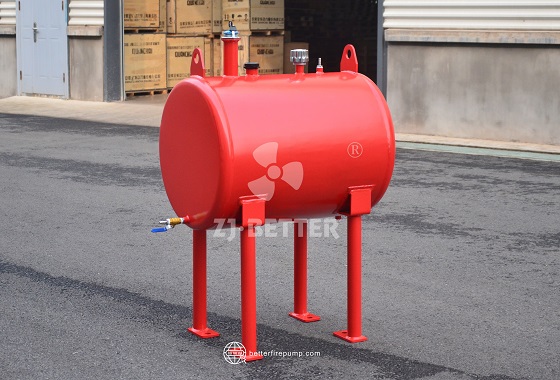
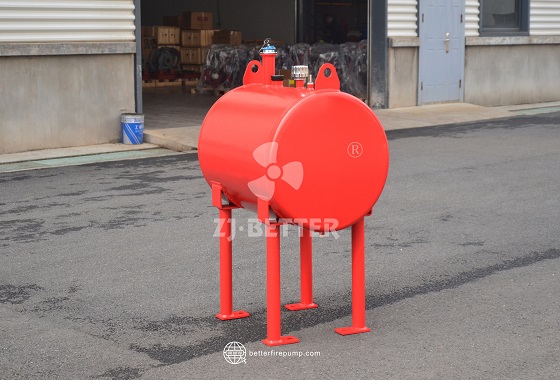
The horizontal fire-fighting pressure tank features a cylindrical steel vessel supported by legs. It is designed for pressure storage, fluctuation buffering, and auxiliary pressure supplementation within fire-fighting piping networks, and is suitable for installation alongside fire pumps and jockey pumps in fire pump rooms.
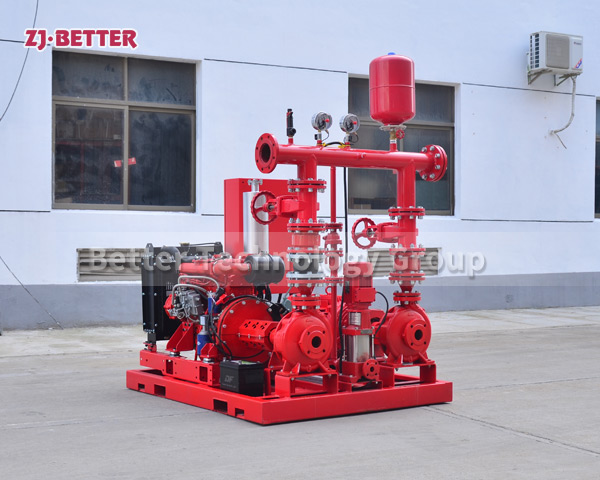
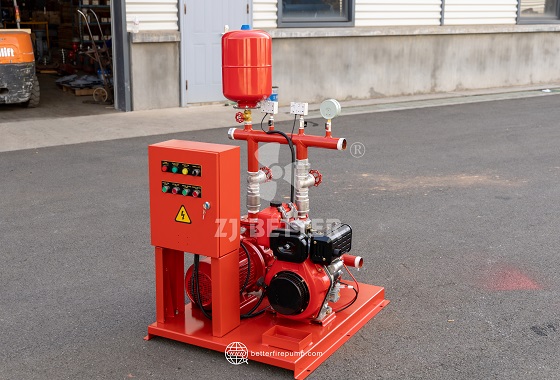
A horizontal fire-fighting pressure tank serves as a critical pressure storage and buffering component within a fire-water supply system. It is primarily designed to store a volume of water under pressure, acting as a buffer against system pressure fluctuations and providing supplementary pressure when the fire-fighting piping network is in standby mode or operating under low-flow conditions. The unit shown features a horizontal cylindrical tank mounted on support legs; its design is streamlined, with multiple legs at the base that allow for secure installation tailored to the specific spatial constraints and piping layout of a fire pump room. Unlike a simple water storage tank, a fire-fighting pressure tank stores potential energy in the form of pressurized water. When the pressure in the piping network shifts, the tank provides supplementary pressure compensation, helping the fire-water supply system maintain a relatively stable standby pressure. Its horizontal configuration allows for flexible positioning based on the pump room’s dimensions, foundation conditions, and the orientation of inlet and outlet piping. It is designed to be integrated with fire pumps, jockey pumps (pressure-maintenance pumps), pressure gauges, pressure sensors, and control equipment. The horizontal design facilitates on-site positioning and piping connections, while the support legs ensure a stable installation, which also simplifies future inspections and maintenance. During installation, the placement must be determined based on the tank’s dimensions, design pressure, piping connection points, and site foundation conditions, while ensuring sufficient space is reserved for maintenance and operational access. During the operation of a fire-water supply system, pressure within the piping network does not remain perfectly constant; factors such as low-flow water usage, minor leaks, or the starting and stopping of equipment can cause pressure variations. The fire-fighting pressure tank uses its stored pressurized water to buffer these fluctuations. When system pressure drops, it provides supplementary water and pressure support, thereby reducing the frequency with which the main fire pump is triggered by minor pressure changes—ultimately improving the standby operational status of the fire-fighting equipment. In buildings, industrial facilities, warehouses, and other fixed fire-water supply installations that require the piping network to remain pressurized over the long term, the pressure tank can be used in tandem with a jockey pump. While the jockey pump handles water replenishment in response to pressure changes, the pressure tank manages pressure storage and buffers fluctuations; together, they ensure smoother and more stable pressure regulation within the fire-fighting piping network. It should be noted that a pressure tank serves as an auxiliary component within a fire-fighting water supply system; it cannot replace the primary fire pump for high-flow water delivery during a fire event. In practical engineering, the parameters for each piece of equipment must be determined based on the design requirements of the overall fire-fighting system. The tank itself is constructed of steel and can be configured according to specific project requirements, including design pressure, water storage capacity, connection dimensions, and the installation environment. For any given project, key parameters—such as design operating pressure, volume, piping connection methods, and available installation space—must be carefully considered to ensure the pressure tank is appropriately matched with the fire pumps and pressure-stabilizing equipment. In models utilizing a diaphragm-type design, a rubber diaphragm separates the water chamber from the air chamber; compressed air stores potential energy, which, upon a drop in system pressure, causes the air to expand and push the stored water into the piping network. This design minimizes direct contact between the water and the tank’s interior walls, while also helping to dampen pressure fluctuations within the system. From an operational perspective, horizontal fire-fighting pressure tanks offer a straightforward structure, stable installation, pressure storage, and buffering for the piping network; they are also easily integrated with fire pump assemblies. Such tanks are suitable for use in building fire-protection water supply systems, industrial facilities, warehouses, logistics centers, commercial properties, and other environments where fire-fighting piping pressure must be maintained. The top of the tank can be equipped with pressure-monitoring and connection components—such as pressure gauges, sensors, and control systems—to track the equipment’s operational status. In practice, the tank’s volume and operating pressure should be selected in accordance with the fire-fighting system’s design specifications, taking into account factors such as fire pump flow rate and head, the parameters of pressure-stabilizing pumps, and the pressure requirements of the piping network. Overall, horizontal fire-fighting pressure tanks provide essential auxiliary support to fire-fighting water supply systems through pressure storage and buffering. Their leg-supported design allows for secure, fixed installation within fire pump rooms. When properly configured, these tanks help reduce unnecessary pump start-stop cycles during low-flow conditions and enhance the stability of fire-fighting piping networks during long-term standby, making them a highly practical pressure-storage solution for fire-protection pressure-stabilizing water supply systems.