Fire Pump Impeller – Optimized Hydraulic Blade Design for Improved Centrifugal Pump Performance
The impeller of a fire pump features an optimized blade and flow-channel design. By utilizing centrifugal action, it increases the energy of the water flow—a process that directly influences the pump’s flow rate, head, and operational stability. The specific impeller can be selected and matched based on the pump model and required hydraulic parameters.
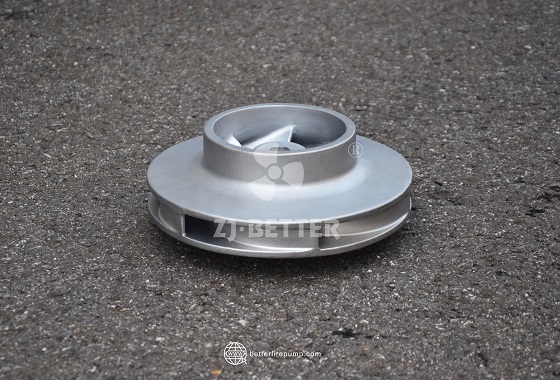
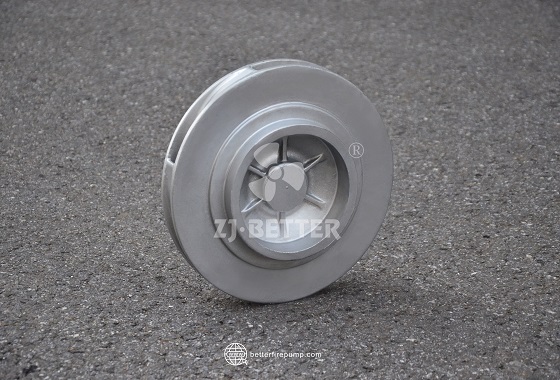
The impeller of a fire-fighting pump is a core hydraulic component within a centrifugal fire-fighting pump. Its primary function is to transfer mechanical energy—supplied by the drive unit—to the water flow. Through high-speed rotation, it generates centrifugal force, which imparts energy to the water entering the pump casing and propels it toward the outlet, thereby producing the flow rate and pressure required by the fire-fighting system. The impeller shown in the image features a closed design, consisting of vanes, a hub, and front and rear shrouds; this configuration is well-suited for the corresponding centrifugal fire-fighting pumps. Parameters such as impeller dimensions, the number and shape of the vanes, the outlet angle, and the size of the flow passages all influence the pump’s hydraulic performance. Consequently, the impeller must be designed in coordination with the specific pump casing, required flow rate, head, and rotational speed. During operation, the impeller rotates at high speed along with the pump shaft. As water enters the center of the impeller, the vanes guide it outward through the flow passages. The centrifugal force increases both the velocity and the energy of the water. Subsequently, as the water moves through the passages within the pump casing, a portion of this kinetic energy is converted into pressure energy, ultimately providing a continuous water supply for fire-fighting purposes. As the rotating component that acts directly upon the water, the impeller’s hydraulic configuration fundamentally determines the pump’s flow rate, head, and operational characteristics; therefore, a well-optimized impeller design is essential for ensuring the performance of a fire-fighting pump. The closed impeller shown in the image utilizes front and rear shrouds to form enclosed flow passages. The vane curvature can be engineered based on the pump’s hydraulic model, ensuring that the water moves in a predetermined direction within the impeller. An effective flow passage design helps minimize unnecessary turbulence and energy loss, fostering a more harmonious hydraulic interaction between the impeller and the pump casing. For fire-fighting pumps, the impeller should not be designed solely to maximize flow or head; rather, it must be selected based on the specific design operating point of the fire-fighting system, ensuring that the impeller dimensions are appropriately matched to the pump casing, shaft, and drive power. The material of the impeller also influences its performance. Depending on the medium being pumped, the operating environment, the pump type, and specific engineering requirements, impellers can be manufactured from various materials, with common choices including cast iron, stainless steel, and bronze. Material selection requires a comprehensive evaluation of mechanical strength, corrosion resistance, water quality conditions, and operational requirements, rather than relying on a single, fixed material standard. For fire-fighting water supply equipment intended for long-term service, the impeller must also exhibit excellent dimensional stability and mechanical reliability to withstand the demands of continuous rotation. The manufacturing quality of the impeller is critical to the overall performance of a fire-fighting pump; factors such as blade dimensions, hub machining, assembly precision, and rotational balance all influence the pump’s operating state. In particular, for high-speed impellers, any significant imbalance can increase shaft vibration and bearing loads. Consequently, the production process must incorporate precise machining, rigorous inspection, and dynamic balancing to ensure the impeller rotates stably under specified operating conditions. Furthermore, the impeller must be securely connected to the pump shaft to ensure the efficient and stable transfer of mechanical energy from the drive unit to the hydraulic components. Proper assembly—maintaining precise alignment between the impeller, pump shaft, pump casing, and sealing structures—is essential to prevent friction, vibration, or a decline in operational efficiency. Given that impellers vary by pump specification—differing in outer diameter, width, blade geometry, and material composition—it is not possible to simply interchange impellers between different pump models. When replacing an impeller, one must ensure an exact match based on the original pump model, flow rate, head, rotational speed, pump casing dimensions, and shaft connection method. From a maintenance perspective, the impeller is a key hydraulic component that requires regular inspection; after prolonged operation, it should be checked for blade wear, corrosion, deformation, or cracking, as well as the fit between the impeller and the pump casing. If an impeller shows significant damage or a loss of performance, it should be inspected and replaced in accordance with equipment maintenance protocols. When selecting a replacement impeller, it is not enough for the external dimensions to match; one must also verify that the hydraulic parameters and mounting dimensions align with the original specifications to avoid unintended changes in flow rate, head, or motor load. As a critical rotating component of a centrifugal fire pump, the impeller’s advantages extend beyond its material composition and physical structure; they also encompass the hydraulic design of its vanes, the optimization of flow passages, manufacturing precision, and its ability to function in synergy with the entire pump system. A well-designed impeller—properly matched with the pump casing, shaft, and drive unit—ensures stable energy conversion and consistent hydraulic output. In practical applications, the appropriate impeller specifications must be selected based on the fire protection system’s design flow rate, head, pump type, rotational speed, and the nature of the pumped medium. This ensures that the impeller operates in harmony with the overall hydraulic performance of the pump, thereby providing reliable flow and pressure support for the fire water supply system.