Home » Fire Pump Set » Are the most important parameters of fire pumps flow and head or flow and pressure?

Are the most important parameters of fire pumps flow and head or flow and pressure?

Answer: First of all, we must understand the relationship between pressure and lift: pressure = liquid density * g * lift (g = 0.981). In fact, the fire water pump can not only transport water, as long as the physical and chemical characteristics and water liquid are fine, but most of them transport water in daily life. The density of water is 1 ton per cubic meter. It can be obtained from the above formula : Pressure=1000*0.981*lift, pressure=0.981*lift, at this time the pressure and lift are almost the same, so whether we refer to lift or pressure, it can basically be regarded as a parameter.
Rated 5/5 based on 285 customer reviews
Share:
Content

Answer: First of all, we must understand the relationship between pressure and lift: pressure = liquid density * g * lift (g = 0.981). In fact, the fire water pump can not only transport water, as long as the physical and chemical characteristics and water liquid are fine, but most of them transport water in daily life. The density of water is 1 ton per cubic meter. It can be obtained from the above formula : Pressure=1000*0.981*lift, pressure=0.981*lift, at this time the pressure and lift are almost the same, so whether we refer to lift or pressure, it can basically be regarded as a parameter.
Inquiry


    More Fire Pump Set

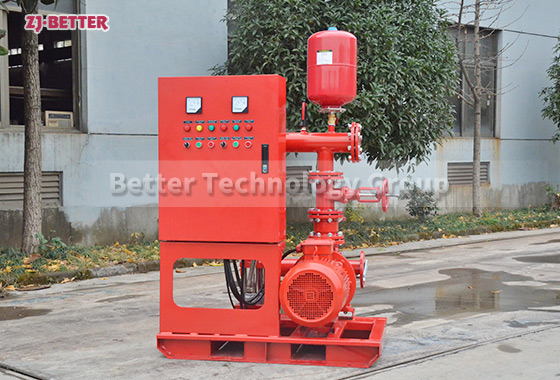
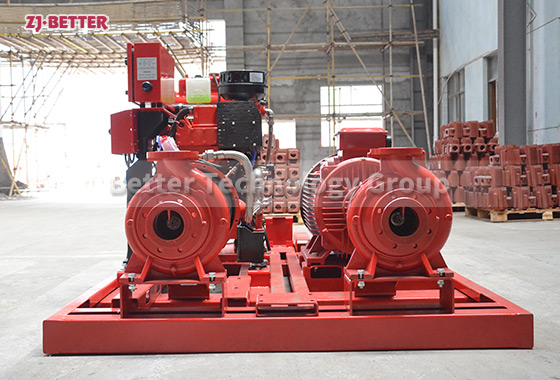
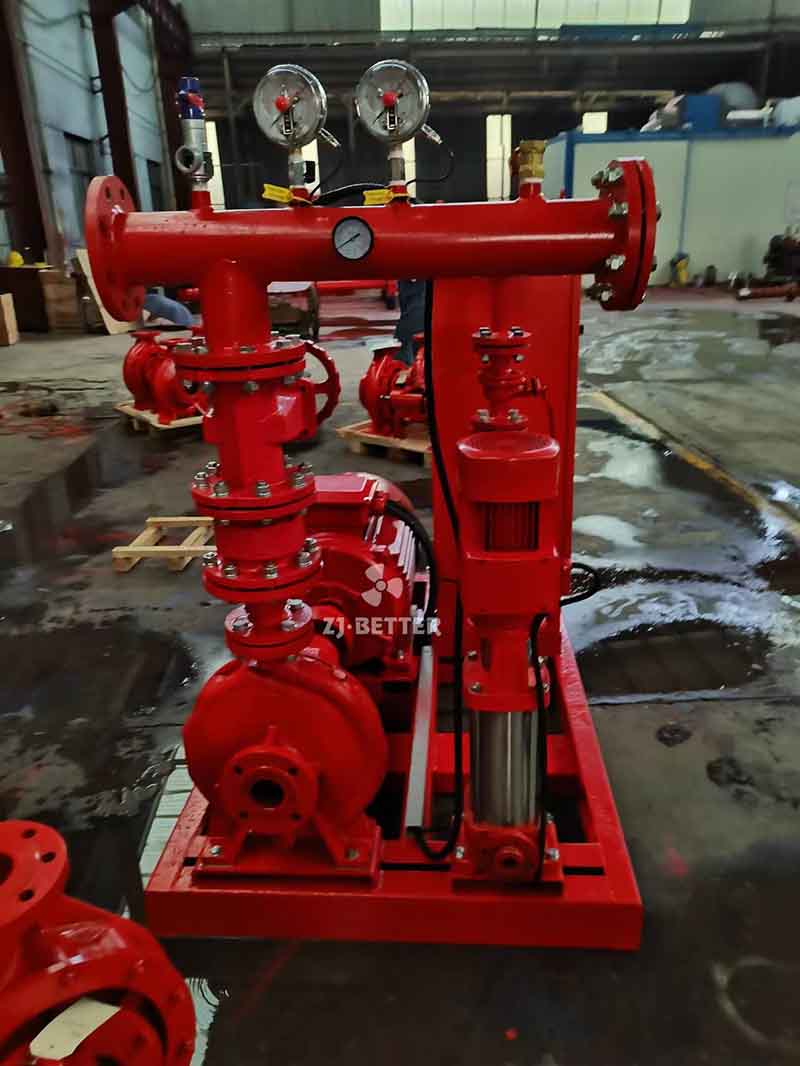
    In the fire fighting pipeline pump, according to the different installation methods can be divided into vertical fire pumps and horizontal fire pumps, many people have questions about these two common pumps, what is the difference between the two? Shanghai Xizhiquan will explain the difference between horizontal and vertical pumps.

    Obviously, different installation methods take up different space. Vertical pipeline pumps are installed vertically, covering a relatively small area, and vertical fire pumps do not require a foundation, while horizontal fire pumps need to be equipped with a base.

    According to the different structures of the two pumps, it can be concluded that there is also a certain difference in the ease of maintenance of the two types of fire fighting pipeline pumps. The impeller of the vertical fire pump needs to be dismantled from top to bottom, which makes maintenance more difficult; the horizontal fire pump only needs to have the inlet pipe removed so that the impeller can be overhauled, which is relatively simple.

    Due to the different inlet and outlet pipe directions, the pipeline connection between vertical and horizontal is also different. As the vertical pump is a bottom-up structure, while the horizontal fire pump is longitudinally arranged on the base, so the motor of the vertical pump and the pump body are connected in the form of sub-mouth connection, while the horizontal pump needs to use couplings to connect with the motor, and the horizontal pipeline pump needs to be corrected regularly.

    Translated with www.DeepL.com/Translator (free version)